Evaluating the Musical Instruments Floral Junk Journal for Mixed Media and Scrapbooking Projects
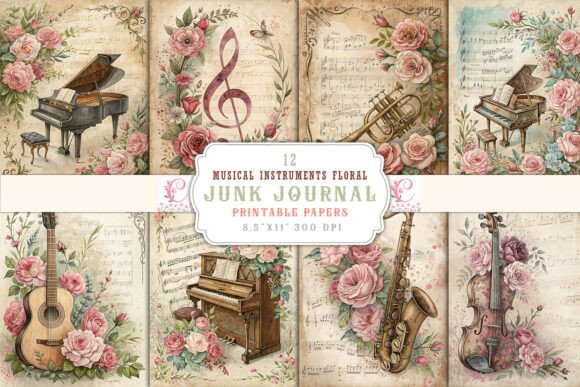
Selecting digital assets for junk journaling requires balancing aesthetic cohesion with technical versatility. The Musical Instruments Floral Junk Journal represents a specific niche within the broader category of printable ephemera, merging two distinct visual themes: classical music iconography and botanical illustration. For crafters aged 20 to 50 who are curating supplies for memory keeping or mixed media art, understanding the practical application of this specific combination is essential before adding it to a digital library. This resource typically includes 12 high-resolution JPG files at 300 DPI in standard 8.5 x 11-inch dimensions, but the value lies not just in the specifications, but in how these elements function compared to single-theme alternatives.
Distinguishing Characteristics of Thematic Fusion
Most digital journaling resources fall into singular categories: either purely floral/botanical or strictly musical/vintage score. The Musical Instruments Floral Junk Journal occupies a hybrid space that solves a common design problem. In traditional scrapbooking, combining separate sheet music backgrounds with separate flower illustrations often results in disjointed color palettes or conflicting lighting styles. By utilizing pre-designed pages where instruments and florals are integrated by a single artist or design team, the user gains immediate visual harmony.
This fusion creates a "romantic vintage" aesthetic that differs significantly from stark antique reproductions or modern minimalist planners. The floral elements soften the rigid lines of musical notation and instrument wood grains, making the pages more approachable for personal journaling rather than strict archival documentation. When evaluating this product against generic vintage packs, consider whether your project benefits from this softened, curated look versus the raw authenticity of unedited historical scans. The former offers ease of use and guaranteed coordination; the latter offers historical accuracy but requires significant editing skill to unify visually.
Technical Specifications and Print Performance
For users comparing digital downloads, technical fidelity is the primary differentiator between professional-grade resources and amateur freebies. This collection provides 300 DPI JPG files, which is the industry standard for crisp printing at 8.5 x 11 inches. When assessing alternatives, verify that competitors offer true 300 DPI rather than upscaled lower-resolution images. Printing a 72 DPI web image at full page size results in pixelation that ruins the tactile experience of a physical journal.
The choice of JPG format over PDF or PNG involves specific tradeoffs. JPGs are universally compatible and easy to manipulate in basic photo editors or phone apps, making them accessible for beginners or those working on tablets. However, unlike layered PSD or TIFF files, JPGs do not allow for the separation of background textures from foreground elements. If your workflow relies heavily on isolating individual violins or roses for decoupage, a flat JPG requires masking tools. Conversely, if you primarily use full-page backgrounds or collage sheets as-is, the JPG format reduces file size and storage overhead without sacrificing print quality.
Paper Selection and Ink Considerations
Digital assets must be evaluated in the context of physical output. High-saturation floral designs combined with dark musical scores can consume significant ink. Users should compare this style against lighter, line-art-based journals if printing costs are a concern. Furthermore, the 8.5 x 11 dimension is optimized for US Letter paper. International users (A4) or those using A5 planners will need to scale these files. While vector-based PDFs scale infinitely, resizing a raster JPG down to A5 maintains quality perfectly, whereas scaling up beyond 8.5 x 11 may introduce softness. This makes the Musical Instruments Floral Junk Journal ideal for standard letter-sized projects or smaller inserts, but less suitable for large-format wall art or oversized ledger journals.
Comparative Use Cases and Best-Fit Scenarios
Determining when this specific asset pack is the right choice depends on the end goal of the creative project. Below is a practical breakdown of fit based on common journaling activities.
- Vintage-Style Scrapbooking: Excellent fit. The integrated theme eliminates the guesswork of matching eras. If you are documenting family history involving musicians or simply love the cottagecore-meets-classical aesthetic, this saves hours of sourcing.
- Daily Diary Writing: Moderate fit. Pages with heavy instrumentation and dense floral borders may reduce writable surface area. Compare against "journaling card" specific packs that prioritize blank space if text density is high.
- Ephemera and Inserts: Strong fit. The 12-file count allows for variety without overwhelming repetition. These work well as tuck-ins, belly bands, or envelope stuffers where small pops of thematic detail are needed.
- Planner Decoration: Conditional fit. Functional planners require utility. If the floral/instrument graphics interfere with calendar grids or tracking tables, opt for subtle watermark versions instead. These bold designs serve better as monthly dividers or dashboard covers.
- Mixed Media Art: Variable fit. For heavy paint and texture users, detailed JPGs might get lost under gesso. However, for light washes, ink splatters, and stamping, the pre-printed base adds depth that plain paper cannot achieve.
Evaluating Alternatives and Limitations
While the Musical Instruments Floral Junk Journal offers convenience and beauty, it is not a universal solution. Understanding its limitations helps prevent buyer’s remorse and ensures resources align with project needs.
Digital vs. Physical Ephemera
A key decision factor is the tactile difference between printed digital files and genuine vintage ephemera. Digital prints, even on matte paper, lack the age-worn texture, foxing, and paper grain of authentic antiques. If your priority is historical authenticity and unique imperfections, original vintage sheet music or pressed flowers are superior. Digital assets like this collection excel in consistency, availability, and hygiene (no mold or dust), making them better for projects requiring multiple matching sets or clean reproduction.
Cohesive Sets vs. Curated Collections
Some journalers prefer building their own aesthetic by sourcing individual elements from disparate origins. This approach yields a highly unique, eclectic result but demands strong design skills and color theory knowledge. The Musical Instruments Floral Junk Journal is a curated alternative. It sacrifices total uniqueness for guaranteed coordination. If you struggle with making different vintage elements look like they belong together, this cohesive set is a strategic tool. If you find pre-matched sets restrictive or repetitive after several uses, investing in individual element packs or brush sets may offer greater long-term flexibility.
Licensing and Commercial Restrictions
Always evaluate usage rights when comparing digital downloads. Most personal-use licenses prohibit selling the printed pages as standalone items or incorporating them into products for sale without modification. If you intend to create sellable handmade cards or tags using these floral instrument designs, verify the commercial license terms. Competing products may offer higher price points that include commercial rights. For hobbyists focused solely on personal memory keeping or diary writing, personal-use licenses provide adequate value at a lower cost.
Practical Workflow Integration
To maximize the utility of these 12 files, consider how they integrate into existing workflows. Since the files arrive in a ZIP folder, organization is the first step. Unlike physical supplies that sit in a bin, digital assets require tagging or folder structuring to remain discoverable. Users accustomed to physical crafting may need to adapt to digital asset management.
For layering projects, these JPG backgrounds pair effectively with solid-colored cardstock or vellum overlays. The opacity of standard printer paper can sometimes make double-sided printing difficult with dark musical scores. A practical workaround is to print the Musical Instruments Floral Junk Journal pages on one side only, using the reverse side for handwriting or attaching photos. Alternatively, printing on lightweight paper allows for translucent layering effects that mimic real tissue paper ephemera.
When creating handmade cards or tags, the 8.5 x 11 dimension offers efficient nesting. Multiple 3x4 or 4x6 cards can be ganged up on a single sheet to minimize waste. Compared to buying pre-cut ephemera packs, printing your own from full-page files requires cutting effort but offers customization in sizing that pre-cut products cannot match.
Making the Final Selection
The decision to acquire the Musical Instruments Floral Junk Journal should rest on three pillars: aesthetic alignment, technical compatibility, and intended application. It serves as a robust middle-ground option for crafters who want the vintage musical-botanical look without the expense and scarcity of true antiques, and without the technical complexity of designing from scratch.
If your projects demand high-resolution, coordinated backgrounds for standard letter-sized printing, and you are comfortable working with flattened JPG imagery, this collection addresses those needs efficiently. However, if you require editable layers, authentic historical artifacts, or commercial-ready assets, exploring specialized alternatives is advisable. Ultimately, digital journaling supplies are tools for expression; selecting the right tool involves honest assessment of both the product's capabilities and your own creative process. By weighing these factors objectively, you ensure that any digital investment enhances rather than complicates your memory keeping and artistic endeavors.